The Trico Charitable Foundation and the Business Development Bank of Canada (BDC) have joined forces to boost support for Canada’s leading social


The Trico Charitable Foundation and the Business Development Bank of Canada (BDC) have joined forces to boost support for Canada’s leading social

Tuesday, March 24, 2015 5:00 PM to 6:30 PM (MDT) $15.00; first 100 attendees receive a copy of A to Z Bow Valley College - Chiu School of Business North Campus – Room N124 (Theatre) Join us for a searingly honest conversation with corporate leader and social business guru Liam Black as he presents his new book, The Social Entrepreneur's A to Z. Full of great advice based on his own triumphs and failures, Liam brings his advice to young social entrepreneurs who he engages with around the world. This event is for students hoping to bring social purpose into their careers, for social entrepreneurs looking for a refreshing dose of honesty, for supporters who want to know how to provide better supports, for naysayers who would enjoy some humor, and for anyone who wants to learn more about what it means to use markets to solve social problems.
Written: by Liz Weaver, Vice President – Tamarack, an Institute for Community Engagement Revised on January 26, 2015 By now we know
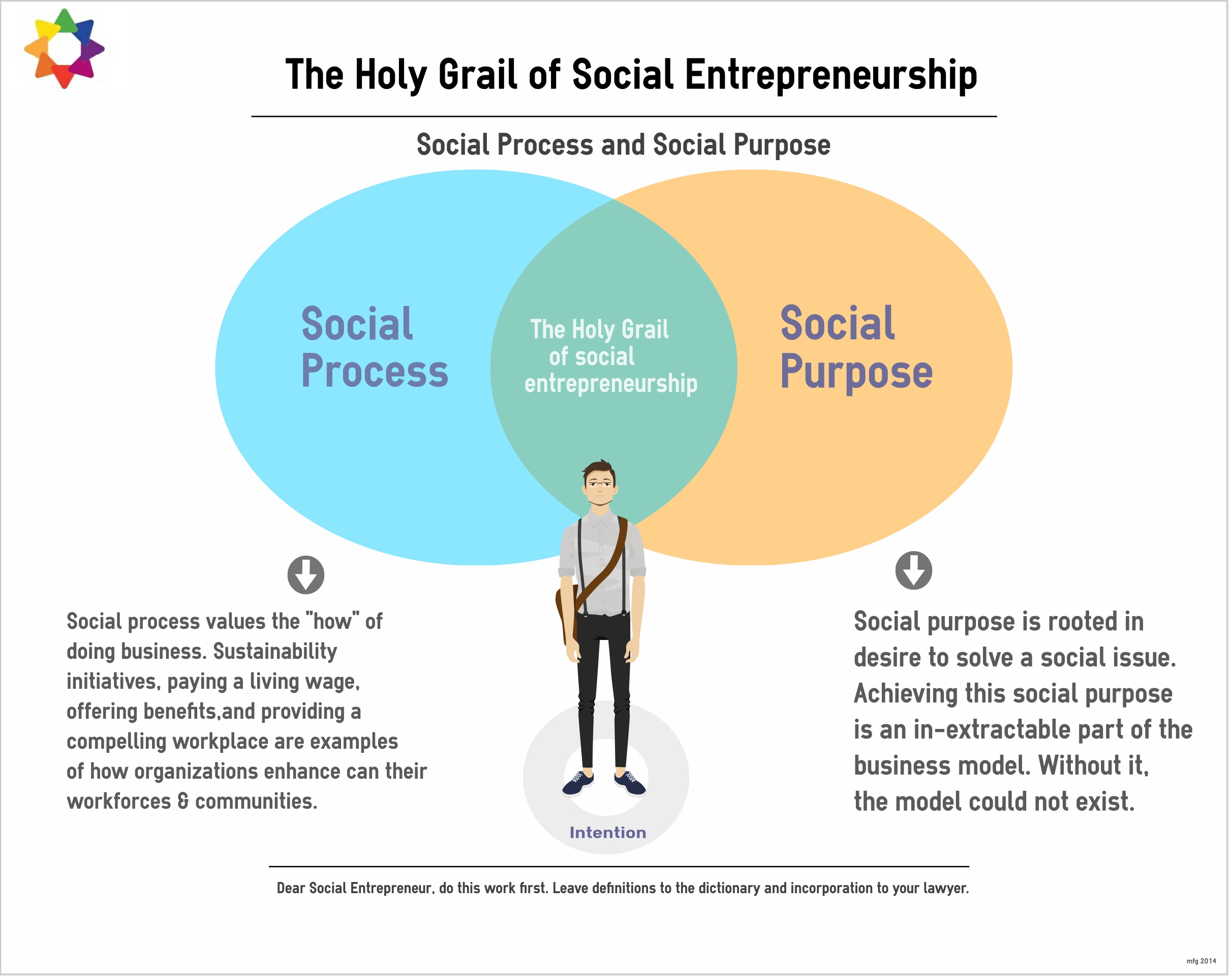
We’re often asked for our definition of social entrepreneurship. In the past three years, our answers have morphed. We started purely on the non-profit side, but encountered problems whereby “everyone” was becoming a social entrepreneur. As we shifted toward the for-profit side, we started to rub up against CSR and social-washing concerns. Instead of broadening our ability to discuss the possibility of social entrepreneurship, we found ourselves increasingly walled within incorporation definitions. A long time ago, I argued for our ability to hold the broadest definition of social entrepreneurship that we possibly could - so that we might experience and learn from the models holding the greatest yields. And yet, over time, I have found myself sniffing for flaws in business model construction. “Is that really social impact?” “Is selling to government actually a market opportunity?” “Does receiving a subsidy take away the sparkle of the idea?” Last spring, I joined the Futurpreneur Canada Action Roundtable in Calgary to discuss the needs of advancing entrepreneurship across the country. I listened to entrepreneurs describe their dedication to the community, to their employees, and to creating an organization that was more than just about business (that was about more than just business). They talked about living wages, volunteer days, health benefits, professional development, community engagement, and employee ownership. When asked as to whether these elements equaled social entrepreneurship, my gut was no, but my head kept asking “why not”? In short, social change was not the goal. However, when I have looked at social enterprise models with social as the goal, often I am confounded by the use of volunteers or beneficiaries as “staff” or government as the sole purchaser. There may well be social purpose to these organizations, but they lack the elements described above – the social process. Social process: Values the “how” of doing business. Sustainability initiatives, paying a living wage, offering benefits, and providing a compelling workplace are examples of how organizations can enhance their workforces and communities. Social purpose: Roots itself in the desire to solve a social issue. Achieving this social purpose is an in-extractable part of the business model. Without it, the model could not exist. Unpacking these concepts required us to start from one vantage point, not definitions, not incorporations, not business models, but rather from “intentionality”. If we started back at square one, at the point of intention, how should a social entrepreneur start building their business model.