Blog

Shining light on our thinking & doing, our epiphanies & struggles, & our movement.

The Holy Grail of Social Entrepreneurship?

We’re often asked for our definition of social entrepreneurship.

In the past three years, our answers have morphed. We started purely on the non-profit side, but encountered problems whereby “everyone” was becoming a social entrepreneur. As we shifted toward the for-profit side, we started to rub up against CSR and social-washing concerns. Instead of broadening our ability to discuss the possibility of social entrepreneurship, we found ourselves increasingly walled within incorporation definitions.

A long time ago, I argued for our ability to hold the broadest definition of social entrepreneurship that we possibly could – so that we might experience and learn from the models holding the greatest yields. And yet, over time, I have found myself sniffing for flaws in business model construction.

“Is that really social impact?”

“Is selling to government actually a market opportunity?”
“Does receiving a subsidy take away the sparkle of the idea?”

Last spring, I joined the Futurpreneur Canada Action Roundtable in Calgary to discuss the needs of advancing entrepreneurship across the country. I listened to entrepreneurs describe their dedication to the community, to their employees, and to creating an organization that was more than just about business (that was about more than just business). They talked about living wages, volunteer days, health benefits, professional development, community engagement, and employee ownership.

When asked as to whether these elements equaled social entrepreneurship, my gut was no, but my head kept asking “why not”? In short, social change was not the goal.

However, when I have looked at social enterprise models with social as the goal, often I am confounded by the use of volunteers or beneficiaries as “staff” or government as the sole purchaser. There may well be social purpose to these organizations, but they lack the elements described above – the social process.

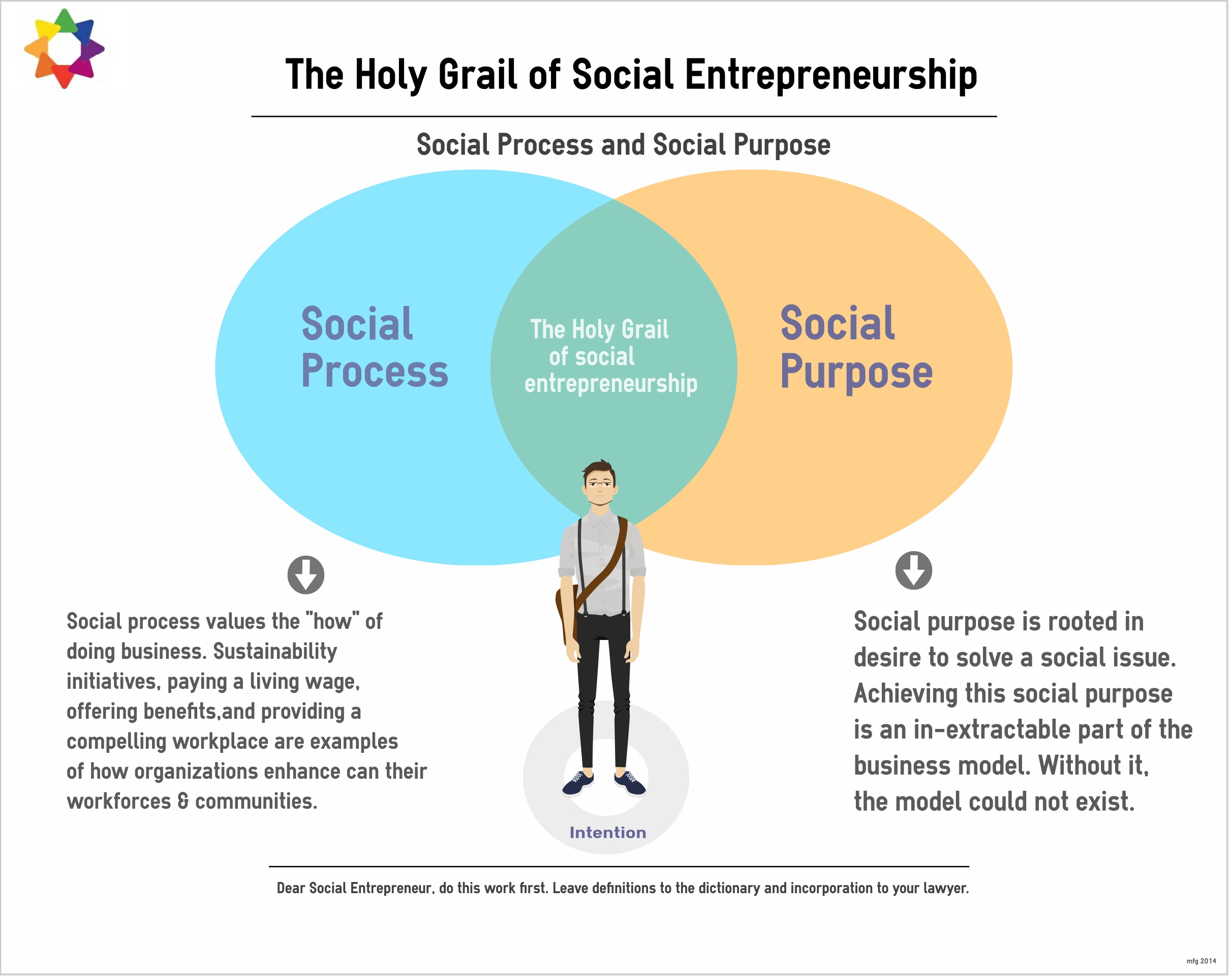
Social process: Values the “how” of doing business. Sustainability initiatives, paying a living wage, offering benefits, and providing a compelling workplace are examples of how organizations can enhance their workforces and communities.

Social purpose: Roots itself in the desire to solve a social issue. Achieving this social purpose is an in-extractable part of the business model.

Without it, the model could not exist.

Unpacking these concepts required us to start from one vantage point, not definitions, not incorporations, not business models, but rather from “intentionality”.

If we started back at square one, at the point of intention, how should a social entrepreneur start building their business model.

Read More »

The Trouble with Transformation Creep

The mantra for transformative change has become ubiquitous. After all, who would opt for treating symptoms, often derisively labeled as band-aids, over striving for a cure? While the clarion call of transformation also beckons for us, we’re concerned by a dynamic emerging between individuals taking community action because they saw a “simple” need (kids need shoes, women shelters need soup) and the analysis of those actions by those who call for transformative change. Whether these interventions come through the lens of philanthropy, humanitarianism, or economic development and regardless of whether they are individual actions or those taken by organizations, we risk losing much by judging all social initiatives against the standard of transformation.

Read More »

Focusing on the ‘how to’: emergent philanthropy debate must evolve

As a small and relatively new private foundation, we were intrigued by Kania, Kramer & Russell’s discussion of an emergent philanthropy framework. While our initial debates focused on the ‘newness’ and the key elements highlighted in their article were theoretically interesting, we were more attracted to the ‘how to’ elements outlined in the ‘How to move to an emergent model’ section.

For us, the authors’ move away from their views on strategic philanthropy does not mean that emergent philanthropy loses its own requirement to be strategic. Rather, it honours the notion that the shift from predictive to emergent models requires different processes, communication and cultures to ensure that we can describe the impact of what we are doing.

To this end, the ultimate potential of the article lies in its attempt to explain how emergent philanthropy can be done. Sadly, this does not seem to be the focus of much of the discussion that has occurred. This strikes us as a squandered opportunity. Imagine the incredible value of all the organizations that participated in this debate talking about ‘co-creating strategy’, ‘working the attractors’ and ‘improving system fitness’ – do they embrace these elements, what has worked, what hasn’t, what have they learned? We are sharing our story in the hopes that it inspires more experienced foundations to join a discussion of the ‘how to’ aspects of the article.

Read More »

Ashoka and Trico Foundation partner to develop new Social Finance Framework

Working collaboratively with thought leaders and pioneers in the space and Ashoka’s network of 3,000 Fellows, Ashoka SFS seeks to articulate a new Social Finance Framework that offers social entrepreneurs, investors and colleagues insights, new opportunities and new trends based on a in-depth review of Ashoka’s Fellows using market forces to create social change.

Read More »

Trico Charitable Foundation and Mount Royal University partner to serve YYC Social Enterprises

Trico Foundation Charitable Foundation has made a three-year commitment totaling $15,000, to help Calgary’s social enterprises while spotlighting the talents and resources of Mount Royal University.

Each year for the next three years the foundation will hire one Mount Royal student to provide services to a variety of social enterprises in Calgary. The student will be selected in consultation with Mount Royal and will have skills identified as needed by a number of social enterprises in Calgary.

Read More »

Financial Analyst, Impact Investing Opportunity

New Market Funds Society (NMFS) is a new foundation-sponsored registered charity established to develop impact investment opportunities for foundations and other investors and to provide strong community based non-profits and blended value businesses with access to investment capital. This is an exceptional opportunity to be part of a new impact investment management firm.

Read More »

Lysol Wipes

Our first stop was our Community Center. We asked, “what is needed?”

Lysol wipes.

Also, food for volunteers on New Street.

Load baby in car, head to store. Done. That was within the realm of how we could help right then.

Read More »

2013 Social EnterPrize Call for Applications

“We were so delighted to be awarded the Best Emerging Social EnterPrize award by the Trico Foundation. The greatest effect was that we had our name out there, people started looking at us, and respecting the work that we did” said Brian Postlewait of Mission Possible of their 2011 award.”

Read More »
  • Categories

  • Archives